Privacy
Guide
A practical guide to preparing your documents, understanding verification, and planning your transition into practice.
Soliman Oushy, MD
Most of us learn about credentialing after we sign our first attending contract. A medical staff coordinator sends a long application, starts asking for documents from every stage of training, and explains that we cannot begin seeing patients until the file clears committee. Residency and fellowship rarely cover any of this.
That matters because credentialing is the most common reason new physicians start later than planned. Data from the Association for Advancing Physician and Provider Recruitment (AAPPR) puts the average interval between signing a contract and starting work at 112 days. About 1 in 7 physicians waits nearly six months. Much of that delay is avoidable: 42% of organizations report that the main holdup is waiting for something from the physician.
Credentialing, privileging, and payer enrollment
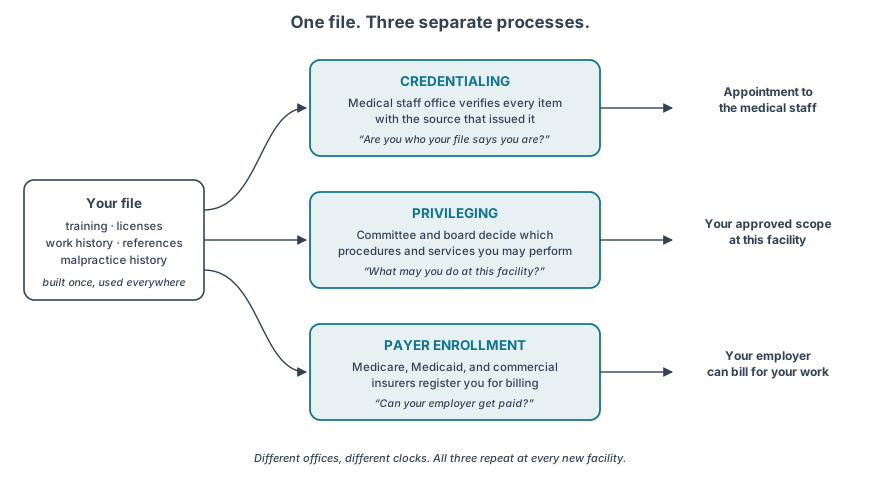
These terms are often used as though they mean the same thing. In practice, they are separate processes, usually handled by different offices and moving on different timelines.
Credentialing verifies your professional record: medical school, residency, fellowship, licenses, board status, work history, and malpractice history. The hospital confirms each item directly with the organization that issued it. This is primary source verification (PSV), a requirement under the standards used by hospital and health-plan accreditors, including The Joint Commission, NCQA, and CMS through its Conditions of Participation.
Privileging determines the clinical work you may perform at a particular facility. Once your credentials establish that you are licensed and appropriately trained, the hospital reviews your training, case volume, and current competence before granting specific procedural and clinical privileges. Privileges are facility-specific.
Payer enrollment registers you with Medicare, Medicaid, and commercial insurers so your employer can bill for your services. It often runs alongside credentialing but follows its own schedule. A delay in payer enrollment does not stop you from seeing patients, but it does prevent your employer from collecting payment for that care.
Your first job will involve all three. If you work at a hospital, an ambulatory surgery center, and an outpatient practice, expect to repeat at least part of the process for each site.
How long credentialing takes
Allow 90 to 180 days between submitting a complete application and receiving a final decision. The American Medical Association (AMA) advises residents that the full process may take as long as 180 days. In an AAPPR survey of hiring organizations, 70% said credentialing and privileging took 3 to 4 months, while 14% reported 5 to 6 months. Only 1% completed the process in less than a month.
An initial application commonly includes 20 to 30 items that must be checked independently. Your medical school confirms your degree, your program director confirms your training, and each state medical board confirms your license. The hospital also queries the National Practitioner Data Bank (NPDB) and checks federal exclusion lists maintained by OIG and SAM. The verification phase alone often takes 60 to 90 days.
Once verification is complete, the application enters the committee cycle. The credentials committee reviews the file, the department chair makes a recommendation, and the medical executive committee and hospital board provide final approval. Because these groups usually meet monthly, committee deadlines matter. Missing the September packet deadline by a few days may push review into October.
What the medical staff office verifies
At a minimum, expect the medical staff office to verify the following:
Identity and NPI. You will need a National Provider Identifier early in the process. It is free and takes only a few minutes to obtain through the NPPES portal. If you do not already have one, apply during residency.
Education and training. Your medical school, residency, and fellowship are verified directly with each institution. International medical graduates must also have their ECFMG certification verified.
Licensure. Every state medical license you hold, active or expired.
DEA registration. This is the federal registration required to prescribe controlled substances. Some states also require a separate controlled-substance registration.
Board certification or eligibility. Verified with your specialty board.
Work history. List every clinical position and account for any gaps. The AMA advises residents to be prepared to explain gaps longer than 30 days. If you had time away between residency and fellowship, write a brief explanation and save it with your other documents.
Malpractice history. The hospital will review your liability coverage and claims history. During training, you were covered under your program’s policy. Ask your GME office for a certificate of insurance and a claims history letter before you leave; obtaining either document later can be surprisingly difficult.
NPDB query. The hospital queries the Data Bank directly. You can also run a self-query to review the same information. Searching is free with an account, while a certified response costs a few dollars per year. It is worth doing before your first application so that you can address any unexpected information early.
Sanctions and exclusions. OIG exclusion list, SAM.gov, and state board actions.
Peer references. Most applications request at least three physicians who know your clinical work, often including your program director. Ask permission before listing them, confirm their contact information, and let them know when the forms are sent. An unanswered reference request can hold a file without generating an obvious alert.
Health status attestation. You will attest that you can perform the privileges requested. The facility may also request immunization records and TB screening results.
Your document checklist
Create one backed-up digital folder with the following:
Medical school diploma and transcripts
Residency and fellowship certificates
USMLE or COMLEX transcripts
ECFMG certificate (if applicable)
All state medical licenses
DEA certificate
Board certification or board eligibility documentation
Current CV in month/year format with no unexplained gaps
Case or procedure logs from training, where your specialty keeps them
Certificate of insurance and claims history from every prior employer or program
Immunization records and recent TB test
Government-issued photo ID and passport-style photo
Three to five peer references with current phone and email
Written explanations for any training interruptions, leaves, or gaps
Keep this folder current throughout your career. Recredentialing occurs every 2 to 3 years, and each new hospital, locums assignment, or telehealth platform will ask for much of the same information.
The 12-month preparation timeline
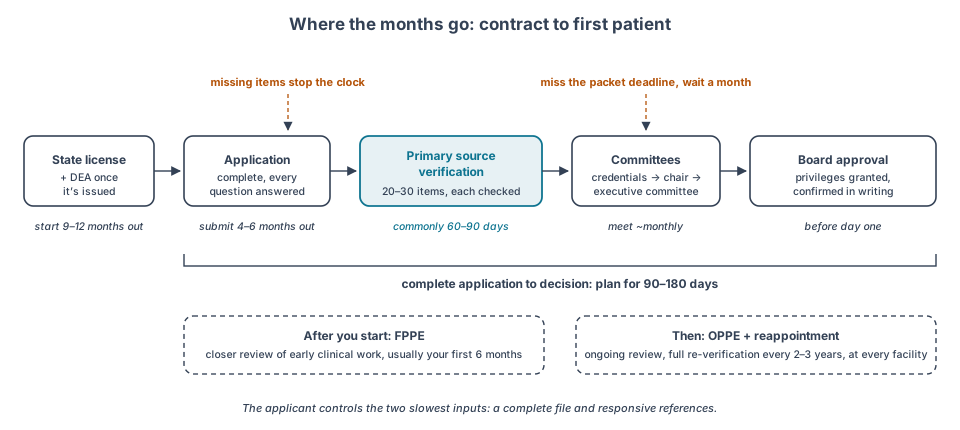
Work backward from your intended start date, which is often August or September for physicians finishing training.
12 months before starting (the beginning of your final year): Obtain an NPI if you do not already have one. Review the databases employers use, including your AMA Physician Profile and FSMB record, and correct any errors. Begin assembling your document folder. If your job search spans several states, the Interstate Medical Licensure Compact now covers more than 40 states and may expedite additional licenses if you qualify.
9 to 12 months before starting: Apply for a state medical license as soon as you know where you will practice. Licensure often sets the pace for everything that follows. The AMA recommends beginning roughly six months before the license is needed, and 38% of organizations cited state licensing as a cause of delayed start dates. Some boards take 60 to 90 days; AAPPR has reported backlogs of up to nine months in certain states. If your target state accepts it, consider the Federation Credentials Verification Service (FCVS), which stores a verified set of core credentials for reuse with state boards.
6 to 9 months before starting: Request the credentialing application during the same week you sign your contract. Ask the medical staff office when the credentials committee meets, when a complete file is due for that meeting, and who will coordinate your application. This is also the time to confirm your peer references.
4 to 6 months before starting: Submit the entire application. Incomplete applications are the most common obstacle in the process, and verification usually does not begin until every required item has arrived. Answer each question, disclose anything that could be interpreted as ambiguous, and attach a short explanation when needed. Once your state license is issued, apply for DEA registration, currently $888 for a three-year registration under 21 CFR 1301.13. Create or update your CAQH profile for payer enrollment and set a reminder for re-attestation.
2 to 4 months before starting: Reply to additional requests within 24 to 48 hours. Check in with your coordinator every week or two, follow up with references who have not responded, and confirm that your file will be included in the next committee packet.
During the final 2 months: Your file should move through committee review, the department chair’s recommendation, and board approval. Before your first day, obtain written confirmation of your privileges, including any temporary or provisional status. Continue completing payer-enrollment items as they arrive.
What to expect after you’re approved
Credentialing continues after the hospital approves your initial application.
Focused Professional Practice Evaluation (FPPE). Under Joint Commission standards, every newly privileged physician completes a defined period of closer review, typically during the first six months of clinical work. This is routine for new appointees and does not imply concern about your performance.
Ongoing Professional Practice Evaluation (OPPE). After FPPE, the hospital reviews performance data more than once a year. Those reviews inform future reappointment decisions.
Reappointment. Every facility re-verifies your credentials and renews your privileges every 2 to 3 years. Licensure, DEA registration, board certification, and malpractice coverage are monitored between cycles, and a lapse can trigger an automatic suspension of privileges.
The process also starts again whenever you add a facility, whether that is a second hospital, an ambulatory surgery center, or a telehealth practice.
Common mistakes that delay new attendings
Waiting for a signed contract before beginning the state license application
Submitting an almost-complete application and assuming verification will begin while the remaining items are gathered
Listing references without warning them, then not following up
Unexplained gaps between med school, residency, and fellowship
Leaving training without a malpractice claims history letter
Missing the committee packet deadline by days and losing a full month
Allowing a CAQH attestation to lapse after privileges have already been granted, delaying payer enrollment
Assuming someone else is monitoring every deadline
The physicians most likely to start on time approach credentialing as one more graduation requirement: they know what is outstanding, track the deadlines, and follow up before a missing item becomes a delay.
SynAIpse provides a free, physician-owned profile where you can upload your documents, complete primary source verification, and share the resulting file wherever you apply. If you are finishing training this year, request access and begin building your file before the first application arrives.
Frequently asked questions
How long does physician credentialing take?
Allow 90 to 180 days from submission of a complete application to final approval. Most hiring organizations report 3 to 4 months for credentialing and privileging, and the average interval between contract signing and the start date is 112 days. Incomplete applications and state licensure delays are the leading causes of longer timelines.
What is the difference between credentialing and privileging?
Credentialing confirms your education, training, licensure, work history, and malpractice record with primary sources. Privileging is the facility’s decision about the specific procedures and services you may perform there.
When should I start the credentialing process as a resident or fellow?
Begin gathering documents about 12 months before your intended start date and apply for your state license 6 to 9 months in advance. Submit the credentialing application 4 to 6 months before your first day to allow enough time for verification and committee review.
What documents do I need for credentialing?
You will generally need your medical school diploma; residency and fellowship certificates; USMLE or COMLEX transcripts; state licenses; DEA certificate; board certification or eligibility documentation; a CV with no unexplained gaps; malpractice certificates of insurance and claims history; immunization records; case logs; and current contact information for peer references.
What is primary source verification?
Primary source verification (PSV) means that a credential is confirmed directly with the organization that issued it. Your medical school confirms your degree, the state board confirms your license, and your specialty board confirms certification. Accreditors including The Joint Commission, NCQA, and CMS require this process, so hospitals cannot rely solely on copies supplied by applicants.
Can I see what hospitals see when they query the NPDB?
Yes. You can request a self-query from the National Practitioner Data Bank through an account at npdb.hrsa.gov. Searching is free, and a certified response carries a small annual fee. Reviewing it before your first application gives you time to address unexpected information.
Do I need to be credentialed at every hospital separately?
Yes. Each hospital, surgery center, and health plan conducts its own credentialing and privileging process, even though much of the underlying information is the same. Recredentialing then occurs at each facility every 2 to 3 years.
Sources: AMA, Credentialing 101: What resident physicians need to know · AMA, Preparation guide for the physician credentialing process (PDF) · AMA, What might delay the start of your first physician job (AAPPR data) · StatPearls, Credentialing and Privileging Provider Profiling (NCBI) · NPDB, Practitioner self-query · 21 CFR 1301.13, DEA registration fees · Interstate Medical Licensure Compact · AMA, Obtaining a medical license: what resident physicians should know